

| Plant Type | Flowering Perennials |
| Sun Exposure | Part Sun / Shade (3-6 Hrs), Shade (0-3 Hrs) |
| Height | Short (1-3') |
| Moisture | Dry, Medium |
| Bloom Months | May, June, July |
| Moisture Needs | Normal |
| Season of Interest | Summer (Jun-Aug), Fall (Sep-Nov) |
| Ecological Significance | Native Bee Friendly, Butterfly Friendly, Bird Friendly, Hummingbird Friendly |
Description
Big-Leaved Aster is a graceful, shade-tolerant native perennial recognized by its broad, heart-shaped basal leaves and soft lavender-blue daisy-like flowers. Blooming from late summer into early fall, it provides a welcome burst of color in woodland settings when few other shade plants are in flower. The large, velvety leaves form a lush groundcover through spring and summer, while its airy flowering stems rise above to attract pollinators and lighten shaded landscapes. Adaptable and easy to grow, Big-Leaved Aster brings texture, color, and ecological value to woodland edges and shaded gardens.
Ecological Value
Eurybia macrophylla is an important nectar and pollen source for late-season pollinators, especially native bees, bumblebees, butterflies, and skippers. Its seeds are eaten by small birds, such as sparrows and goldfinches, while its foliage provides cover and shelter for woodland insects and small fauna. It also serves as a host plant for several butterfly and moth species, including the Pearl Crescent butterfly. Because it flowers later in the season, it helps sustain pollinators during the transition from summer to fall, playing an essential role in woodland ecosystem continuity.
Ideal Growing Conditions
Big-Leaved Aster thrives in partial to full shade and medium, well-drained soils, naturally occurring in deciduous woodlands and shaded slopes. It prefers loamy or silty soils rich in organic matter and benefits from consistent moisture, though it tolerates dry shade once established. It spreads gradually by rhizomes, forming dense colonies that serve as excellent groundcover under trees and shrubs. While tolerant of a range of conditions, it performs best in dappled light with protection from harsh afternoon sun.
Landscape Uses
Ideal for woodland gardens, shaded borders, and naturalized groundcover plantings, Big-Leaved Aster brings soft color and habitat value to shady landscapes. It pairs beautifully with Wild Geranium, Solomon’s Seal, and Zigzag Goldenrod for a layered and pollinator-friendly understory. Its broad, textural foliage anchors the woodland floor in spring, while its late blooms extend seasonal interest well into fall. Hardy, adaptable, and ecologically beneficial, Big-Leaved Aster is one of the finest native perennials for enriching shaded spaces with lasting beauty and biodiversity.
Big Leaved Aster Native Range
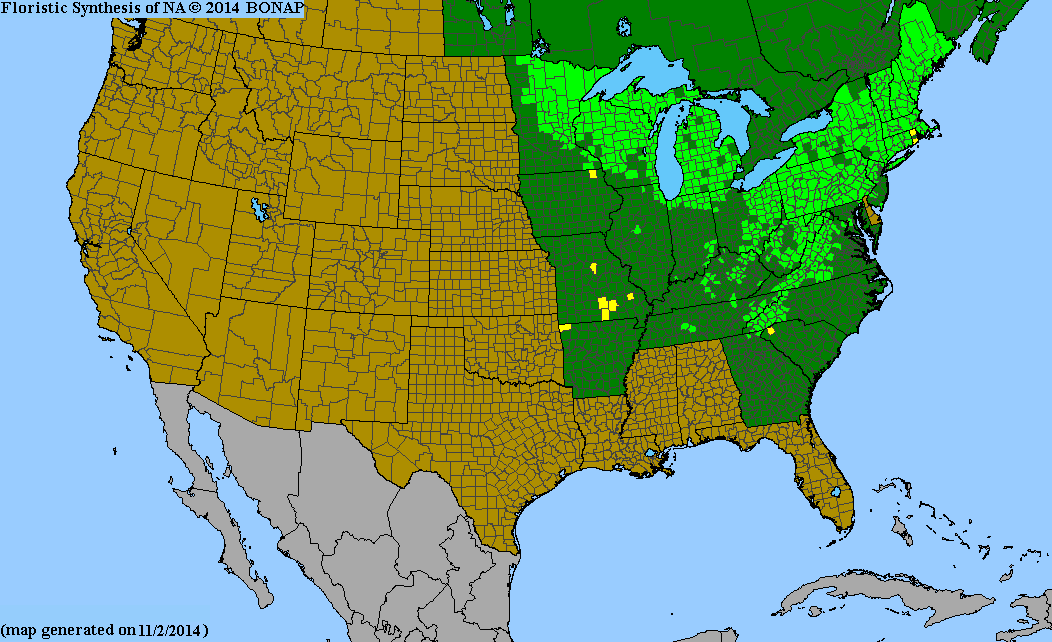
Map Color Key
| Species present in state and native | Species present and not rare | ||
| Species not present in state | Species present and rare |
Kartesz, J.T., The Biota of North America Program (BONAP). 2015. North American Plant Atlas. (http://bonap.net/napa). Chapel Hill, N.C. [maps generated from Kartesz, J.T. 2015. Floristic Synthesis of North America, Version 1.0. Biota of North America Program (BONAP). (in press)].