

| Plant Type | Flowering Perennials |
| Sun Exposure | Part Sun / Shade (3-6 Hrs), Shade (0-3 Hrs) |
| Height | Medium (3-5'), Tall (>5') |
| Moisture | Dry, Medium |
| Bloom Months | May, June, July |
| Moisture Needs | Normal |
| Season of Interest | Summer (Jun-Aug) |
| Ecological Significance | Native Bee Friendly, Butterfly Friendly, Bird Friendly, Hummingbird Friendly |
Description
Black Cohosh is a striking native woodland perennial known for its tall, elegant spires of creamy white flowers that rise high above its dark green, fern-like foliage. Blooming in mid to late summer, the slender, bottlebrush-like flower spikes create a luminous display in shaded settings, often swaying gracefully in the breeze. The finely divided leaves form an attractive, dense base that provides rich texture even after flowering. Long-lived and architectural, Black Cohosh brings a bold yet graceful vertical element to woodland gardens and shaded borders, thriving where few tall perennials do.
Ecological Value
Actaea racemosa provides nectar and pollen for a variety of native pollinators, including small bees, flies, beetles, and butterflies. Its late-season bloom is especially valuable for pollinators in shaded woodland habitats. The flowers emit a light, musky scent that attracts both diurnal and nocturnal insects. Although the seeds are not a major wildlife food, the plant contributes to woodland biodiversity by supporting shade-tolerant pollinator species and maintaining understory structure. Deer generally avoid it, making it a dependable choice for natural areas with browsing pressure.
Ideal Growing Conditions
Black Cohosh thrives in partial to full shade and moist, rich, well-drained soils, naturally occurring in deciduous woodlands, shaded ravines, and forest edges. It prefers humus-rich loam or silty soils with consistent moisture, though it can tolerate short dry periods once established. In garden settings, it performs best when protected from strong afternoon sun and when soil organic matter is regularly replenished with leaf litter or compost. It grows slowly but steadily, forming robust clumps over time.
Landscape Uses
Ideal for woodland gardens, shaded borders, and naturalized understory plantings, Black Cohosh adds height, drama, and ecological value to shaded landscapes. It pairs beautifully with Wild Geranium, Solomon’s Seal, and Ferns for a layered woodland composition. Its tall floral spires draw the eye upward, while its fine foliage adds lush texture below. Hardy, deer-resistant, and long-lived, Black Cohosh is one of the most elegant native perennials for bringing structure and serenity to moist, shaded habitats.
Black Cohosh Native Range
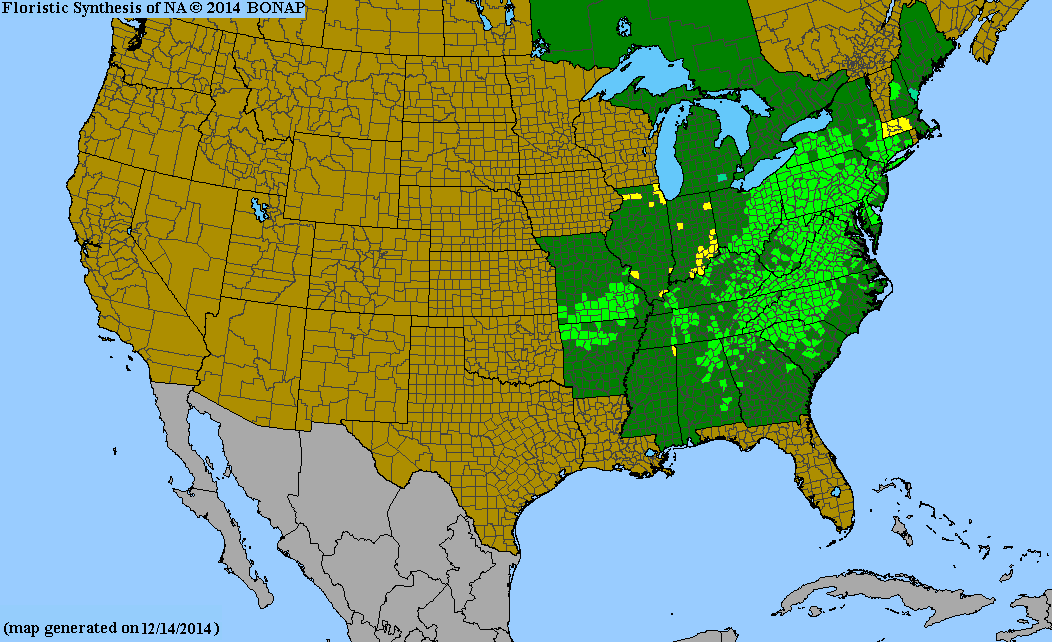
Map Color Key
| Species present in state and native | Species present and not rare | ||
| Species not present in state | Species present and rare |
Kartesz, J.T., The Biota of North America Program (BONAP). 2015. North American Plant Atlas. (http://bonap.net/napa). Chapel Hill, N.C. [maps generated from Kartesz, J.T. 2015. Floristic Synthesis of North America, Version 1.0. Biota of North America Program (BONAP). (in press)].