

| Plant Type | Flowering Perennials |
| Sun Exposure | Full Sun (6+ Hrs), Part Sun / Shade (3-6 Hrs) |
| Height | Short (1-3') |
| Moisture | Dry, Medium |
| Bloom Months | May, June, July |
| Moisture Needs | Flood Tolerant |
| Season of Interest | Spring (Mar-May), Summer (Jun-Aug) |
| Ecological Significance | Native Bee Friendly, Butterfly Friendly, Hummingbird Friendly |
Description
Blue Flag Iris is a striking native wetland perennial admired for its showy lavender-blue flowers and sword-like green leaves. Blooming in late spring and early summer, it brings a refined elegance to ponds, rain gardens, and wet meadows. Each flower features graceful falls marked with white and yellow veining that guide pollinators toward the nectar. The blooms rise above narrow, upright leaves that add vertical texture to moist landscapes. Hardy and dependable, Blue Flag Iris offers both ornamental beauty and ecological function in water-rich environments.
Ecological Value
Iris virginica var. shrevei provides nectar for bumblebees, butterflies, and hummingbirds, which are drawn to its intricate, nectar-rich flowers. Its rhizomes help stabilize soil along wetland edges, reducing erosion and improving water quality. While it is not a larval host plant for butterflies, it offers shelter and structure for aquatic and semi-aquatic insects. Its dense foliage also provides cover for amphibians and small wetland wildlife, making it a valuable contributor to healthy aquatic ecosystems.
Ideal Growing Conditions
Blue Flag Iris thrives in full sun to partial shade and moist to wet soils, performing best in loamy or clay soils that remain consistently damp. It naturally occurs along pond edges, marshes, and slow-moving streams. The plant tolerates shallow standing water up to several inches deep, making it ideal for rain gardens and wetland restoration. It spreads slowly by rhizomes to form elegant colonies over time but is not aggressive. Once established, it requires little care beyond cutting back old foliage in early spring before new growth emerges.
Landscape Uses
Perfect for rain gardens, pond edges, and wet meadows, Blue Flag Iris adds color, structure, and habitat value to water-loving landscapes. It pairs beautifully with Swamp Milkweed, Joe Pye Weed, and Cardinal Flower for a layered, natural wetland aesthetic. Its graceful foliage provides texture year-round, while its vibrant blooms offer early color and pollinator activity. Durable, adaptable, and ecologically beneficial, Blue Flag Iris is an essential choice for gardeners looking to enhance both the beauty and biodiversity of moist or water-rich sites.
Blue Flag Iris Native Range
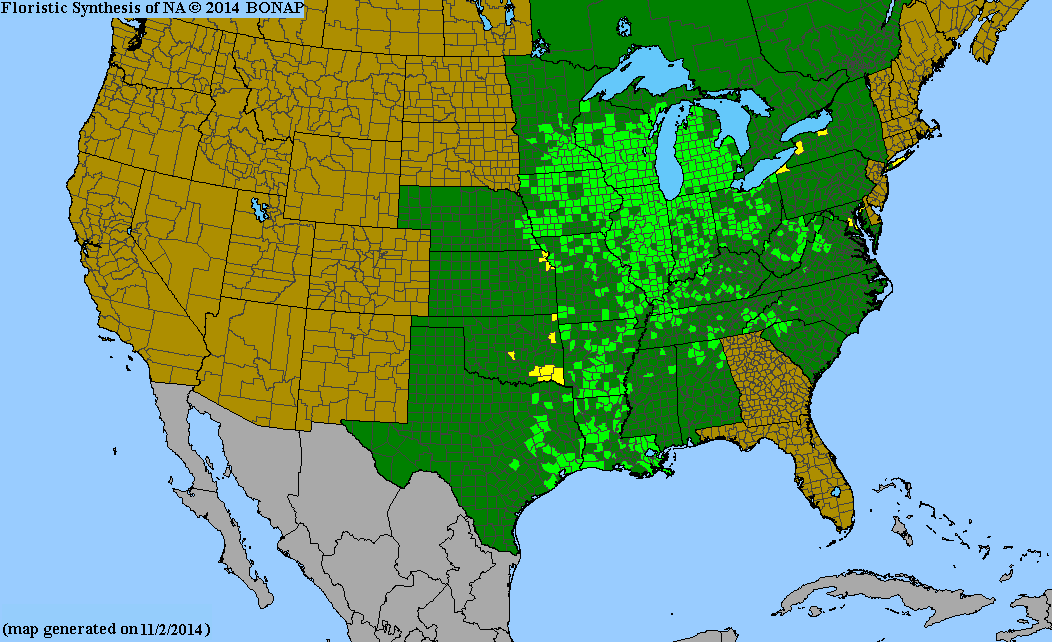
Map Color Key
| Species present in state and native | Species present and not rare | ||
| Species not present in state | Species present and rare |
Kartesz, J.T., The Biota of North America Program (BONAP). 2015. North American Plant Atlas. (http://bonap.net/napa). Chapel Hill, N.C. [maps generated from Kartesz, J.T. 2015. Floristic Synthesis of North America, Version 1.0. Biota of North America Program (BONAP). (in press)].