

| Plant Type | Flowering Perennials |
| Sun Exposure | Full Sun (6+ Hrs), Part Sun / Shade (3-6 Hrs) |
| Height | Short (1-3') |
| Moisture | Medium |
| Bloom Months | April, May, June |
| Moisture Needs | Normal |
| Season of Interest | Spring (Mar-May), Summer (Jun-Aug) |
| Ecological Significance | Native Bee Friendly, Butterfly Friendly |
Description
Golden Alexander is a cheerful, early-blooming native perennial that lights up gardens and prairies with clusters of bright yellow flowers. Blooming in late spring and early summer, it bridges the gap between spring ephemerals and midsummer wildflowers. Its flat-topped flower clusters resemble those of parsley or dill and rise above glossy green, compound leaves on sturdy stems. The plant’s airy structure and vibrant color make it a graceful addition to sunny borders, meadows, and pollinator gardens. Reliable and adaptable, Golden Alexander adds both beauty and ecological function to a wide range of landscapes.
Ecological Value
Zizia aurea is an important host plant for several butterfly species, including the Black Swallowtail, which uses it as a caterpillar food source. Its nectar-rich blooms attract a variety of pollinators—bees, wasps, flies, and beetles—making it a key early-season resource for native insects. The plant’s compact growth also provides cover for ground-dwelling pollinators and beneficial insects. As a native member of the carrot family, it supports a diverse pollinator community while contributing to healthy prairie and meadow ecosystems.
Ideal Growing Conditions
Golden Alexander thrives in full sun to partial shade and medium to moist, well-drained soils. It naturally occurs in open meadows, woodland edges, and along streams, preferring soils rich in organic matter but tolerating clay or sandy loam. Regular moisture promotes strong growth and prolonged bloom, but it can adapt to drier sites once established. It self-seeds lightly under favorable conditions, forming attractive colonies over time without becoming aggressive. Minimal maintenance is needed—simply cut back old stems in fall or early spring.
Landscape Uses
Ideal for pollinator gardens, prairies, and naturalized borders, Golden Alexander brings early-season color and supports essential wildlife activity. It pairs beautifully with Wild Geranium, Blue-eyed Grass, and later bloomers such as Butterfly Weed and Blazing Stars. Its bright umbels contrast well against grasses and add a natural, meadow-like softness to garden plantings. Hardy, long-lived, and ecologically valuable, Golden Alexander is an excellent choice for gardeners looking to support pollinators while adding dependable early color to native landscapes.
Golden Alexander Native Range
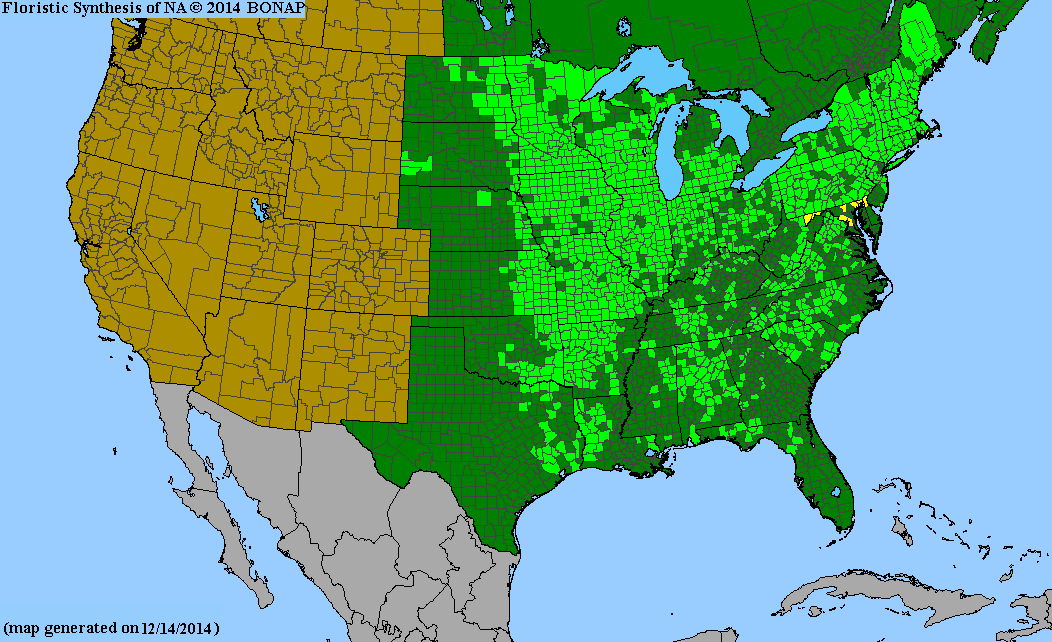
Map Color Key
| Species present in state and native | Species present and not rare | ||
| Species not present in state | Species present and rare |
Kartesz, J.T., The Biota of North America Program (BONAP). 2015. North American Plant Atlas. (http://bonap.net/napa). Chapel Hill, N.C. [maps generated from Kartesz, J.T. 2015. Floristic Synthesis of North America, Version 1.0. Biota of North America Program (BONAP). (in press)].