

| Plant Type | Flowering Perennials |
| Sun Exposure | Shade (0-3 Hrs) |
| Height | Short (1-3') |
| Moisture | Dry, Medium |
| Bloom Months | May, June, July |
| Moisture Needs | Normal |
| Season of Interest | Spring (Mar-May), Summer (Jun-Aug) |
Description
Green Dragon is a fascinating and exotic-looking native woodland perennial related to the more familiar Jack-in-the-Pulpit. Emerging in spring, it produces a single tall stem topped by a distinctive whorl of divided leaflets—often seven to thirteen—resembling a dragon’s outstretched wings. From the base of this leafy umbrella arises a slender green spathe (or sheath) that curves gracefully around a long, tail-like spadix. Though the flowers are subtle and often hidden, their unusual form gives the plant a mysterious beauty. In late summer, a cluster of bright red berries replaces the flower, adding a bold splash of color to shaded forest floors.
Ecological Value
Arisaema dracontium provides food and habitat for woodland wildlife. The berries are eaten by wild turkeys and small mammals, which help disperse the seeds. The plant’s unique flower structure is pollinated by small flies attracted to its faint scent. While not a major nectar or pollen source, it contributes to woodland biodiversity by supporting specialized insect interactions and offering shelter at the forest floor level. Its deep root system helps stabilize soil in shaded, moisture-retentive environments, enriching the structure of woodland ecosystems.
Ideal Growing Conditions
Green Dragon thrives in partial to full shade and moist, rich, well-drained soils high in organic matter. It naturally occurs in woodlands, floodplain forests, and shaded stream valleys. It prefers consistent moisture but not standing water and benefits from a layer of leaf mulch to retain soil humidity. Once established, it is long-lived and slowly forms small colonies through self-seeding. The plant goes dormant by late summer, disappearing until the following spring—so care should be taken to mark its location in garden settings to avoid disturbance.
Landscape Uses
Ideal for woodland gardens, shaded borders, and naturalized plantings, Green Dragon adds a touch of intrigue and wild elegance to native shade gardens. It pairs beautifully with Wild Ginger, Ferns, and Woodland Phlox for a layered woodland composition. Its architectural foliage and unusual flower form make it a natural conversation piece in shady settings. Subtle yet striking, Green Dragon is a rewarding native for gardeners seeking to bring rare beauty and ecological authenticity to moist, shaded landscapes.
Green Dragon Native Range
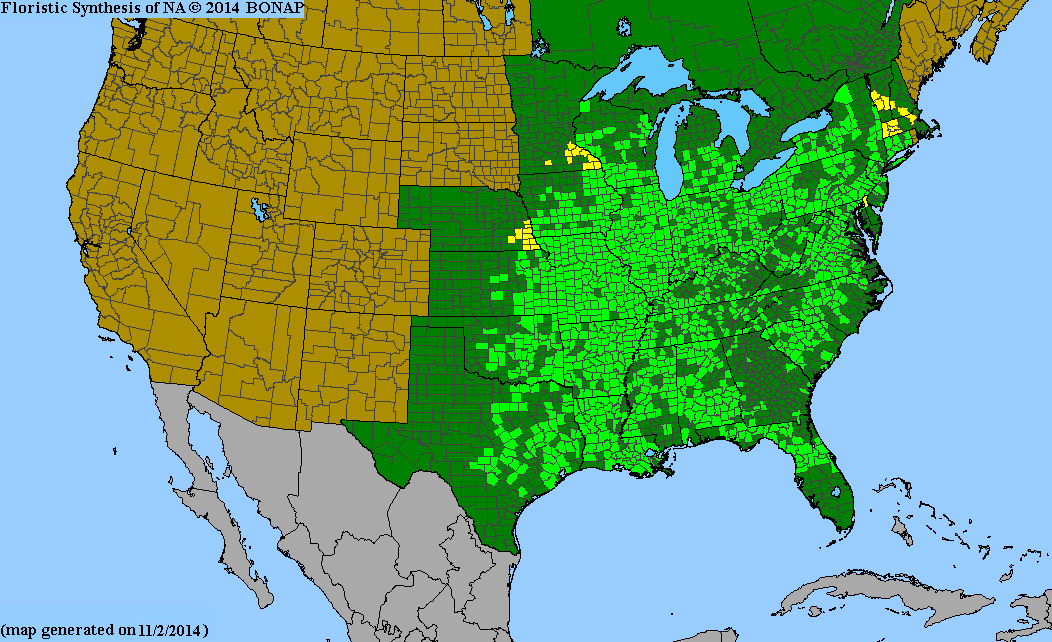
Map Color Key
| Species present in state and native | Species present and not rare | ||
| Species not present in state | Species present and rare |
Kartesz, J.T., The Biota of North America Program (BONAP). 2015. North American Plant Atlas. (http://bonap.net/napa). Chapel Hill, N.C. [maps generated from Kartesz, J.T. 2015. Floristic Synthesis of North America, Version 1.0. Biota of North America Program (BONAP). (in press)].