

| Plant Type | Shrubs |
| Sun Exposure | Full Sun (6+ Hrs), Part Sun / Shade (3-6 Hrs) |
| Moisture | Dry, Medium |
| Bloom Months | May, June, July |
| Moisture Needs | Normal |
| Season of Interest | Spring (Mar-May), Summer (Jun-Aug) |
| Shrub Height | Over 6' |
| Shrub Spread | Over 6' |
| Ecological Significance | Native Bee Friendly, Butterfly Friendly, Bird Friendly, Hummingbird Friendly |
Description
Common Ninebark is a hardy, adaptable native shrub valued for its cascading clusters of white spring flowers and striking exfoliating bark that peels away in thin layers, revealing shades of reddish-brown beneath—hence the name “Ninebark.” Its arching branches and dense, rounded form provide strong structure and year-round visual interest. The lobed, maple-like leaves emerge bright green, deepen through summer, and turn golden or bronze in fall. By late summer, the flowers give way to reddish seed capsules that add texture and color well into autumn. Beautiful, resilient, and ecologically beneficial, Ninebark is a cornerstone shrub for both natural and designed landscapes.
Ecological Value
Physocarpus opulifolius supports pollinators, birds, and beneficial insects throughout the growing season. Its blooms provide nectar and pollen for native bees, butterflies, and flies, while its dense branching offers nesting habitat and cover for songbirds. The dry seed capsules provide a modest food source for birds, and the exfoliating bark shelters overwintering insects and small invertebrates. It is also a host plant for several moth and butterfly species, including the Ninebark Leaf Beetle and the Gray Hairstreak butterfly. With its combination of beauty, structure, and resilience, Ninebark contributes greatly to the biodiversity of woodland edges, stream banks, and native plantings.
Ideal Growing Conditions
Ninebark thrives in full sun to partial shade and dry to moist, well-drained soils, naturally occurring along stream banks, bluffs, and woodland edges. It tolerates clay, rocky soils, and periods of drought once established, making it one of the most adaptable native shrubs in North America. It performs best in well-drained loam and benefits from periodic rejuvenation pruning to maintain its natural shape and encourage healthy growth. Hardy and low-maintenance, Ninebark withstands temperature extremes and urban conditions while maintaining its beauty and vigor.
Landscape Uses
Ideal for hedgerows, slopes, rain gardens, and mixed shrub borders, Common Ninebark provides texture, structure, and multi-season interest. It pairs beautifully with Red Osier Dogwood, Arrowwood Viburnum, and Prairie Dropseed for a diverse and wildlife-friendly planting. Its arching habit, spring blooms, and peeling bark make it equally suitable for naturalized landscapes and ornamental designs. Tough, fast-growing, and ecologically rich, Ninebark is a go-to native shrub for gardeners and restorationists seeking a resilient species that offers both aesthetic appeal and meaningful habitat value.
Ninebark Native Range
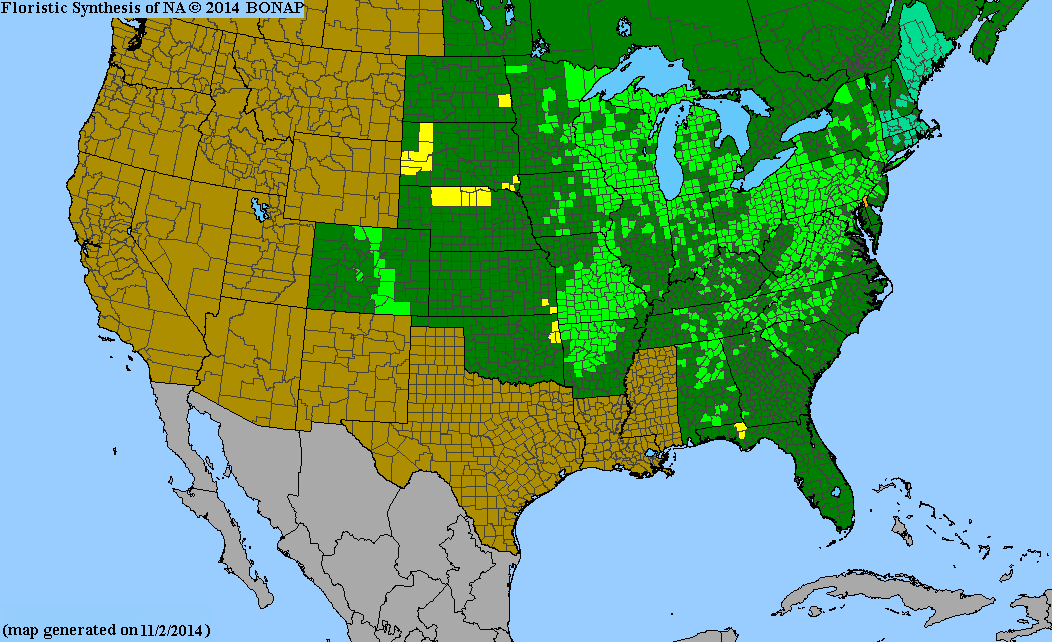
Map Color Key
| Species present in state and native | Species present and not rare | ||
| Species not present in state | Species present and rare |
Kartesz, J.T., The Biota of North America Program (BONAP). 2015. North American Plant Atlas. (http://bonap.net/napa). Chapel Hill, N.C. [maps generated from Kartesz, J.T. 2015. Floristic Synthesis of North America, Version 1.0. Biota of North America Program (BONAP). (in press)].