

| Sun Exposure | Full Sun (6+ Hrs) |
| Height | Short (1-3') |
| Moisture | Dry, Medium, Wet |
| Bloom Months | August, September, October |
| Moisture Needs | Drought Tolerant |
| Season of Interest | Summer (Jun-Aug), Fall (Sep-Nov) |
| Ecological Significance | Winter Bird Feed |
Description
Prairie Dropseed is a graceful, fine-textured native grass valued for its elegant form, year-round beauty, and subtle fragrance. Forming neat, fountain-like mounds of slender green leaves, it brings a soft, flowing texture to prairies and gardens alike. In late summer, delicate, airy flower panicles rise above the foliage, releasing a light, sweet scent often described as coriander or popcorn-like. As the season progresses, the foliage turns shades of copper, gold, and orange, adding rich autumn color that persists into winter. Its tidy habit, shimmering texture, and resilience make Prairie Dropseed one of the most beloved ornamental grasses in native landscaping.
Ecological Value
Sporobolus heterolepis provides excellent habitat and seed resources for wildlife. Its dense mounds offer cover for insects and small animals, while birds, especially sparrows and juncos, feed on its seeds in fall and winter. It also serves as a larval host plant for several butterfly and skipper species, including the Leonard’s Skipper and Ottoe Skipper. With its deep, fibrous root system, Prairie Dropseed helps prevent erosion, supports soil health, and contributes to carbon sequestration—making it both ecologically valuable and environmentally sustainable.
Ideal Growing Conditions
Prairie Dropseed thrives in full sun and well-drained soils, preferring dry to medium moisture levels. It is well adapted to sandy, rocky, or loamy soils and will not tolerate prolonged wetness. Naturally found in upland prairies, it is highly drought-tolerant once established and requires little maintenance. Avoid overly rich or shaded conditions, which can reduce flowering and cause the clumps to open at the center. It is slow to mature but exceptionally long-lived—rewarding patience with decades of beauty and reliability. Cut back old foliage in early spring before new growth emerges.
Landscape Uses
Perfect for prairie plantings, borders, and mass plantings, Prairie Dropseed adds texture, motion, and structure to the landscape. Its refined form contrasts beautifully with coarser native species like Blazing Stars, Coneflowers, and Wild Bergamot. It’s ideal for meadows, slopes, and dry gardens where erosion control and low maintenance are priorities. Because of its compact size and graceful habit, it also fits well in formal landscapes or along walkways. Combining ornamental elegance with ecological function, Prairie Dropseed is one of the most versatile and enduring native grasses for both design and conservation.
Prairie Dropseed Native Range
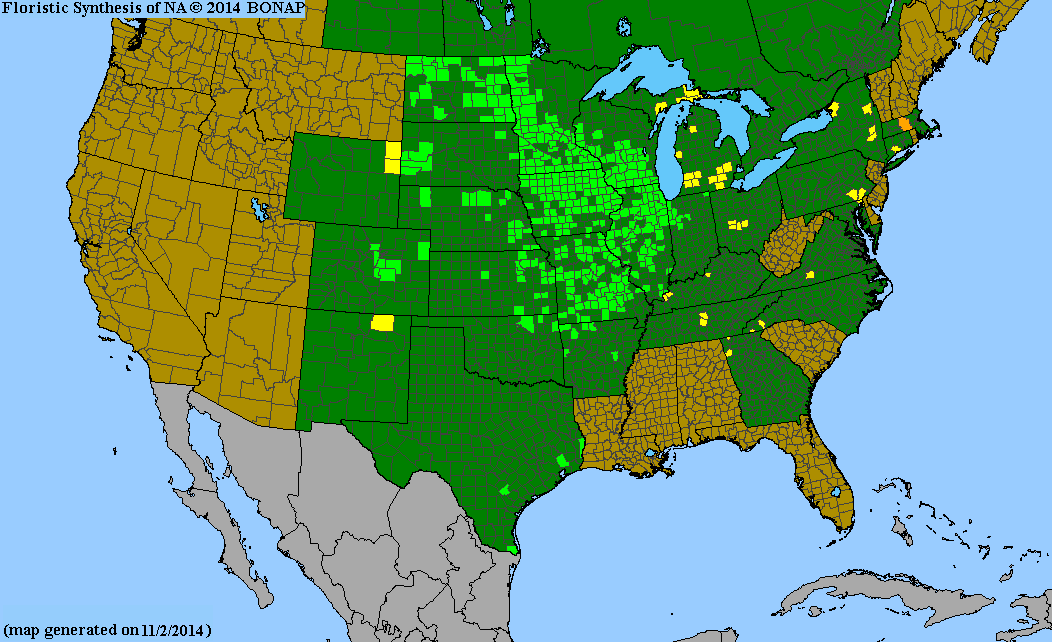
Map Color Key
| Species present in state and native | Species present and not rare | ||
| Species not present in state | Species present and rare |
Kartesz, J.T., The Biota of North America Program (BONAP). 2015. North American Plant Atlas. (http://bonap.net/napa). Chapel Hill, N.C. [maps generated from Kartesz, J.T. 2015. Floristic Synthesis of North America, Version 1.0. Biota of North America Program (BONAP). (in press)].