

| Sun Exposure | Part Sun / Shade (3-6 Hrs) |
| Height | Short (1-3') |
| Moisture | Dry, Medium |
| Bloom Months | May, June, July |
| Moisture Needs | Flood Tolerant |
| Season of Interest | Spring (Mar-May), Summer (Jun-Aug), Fall (Sep-Nov) |
Description
Gray’s Sedge is a distinctive and ornamental native sedge valued for its unique, star-shaped seed heads that resemble medieval maces or spiky orbs. Blooming in late spring to early summer, the plant produces sturdy, upright stems topped with these striking seed clusters, which mature to tan and persist into fall and winter. Its broad, arching leaves form attractive, fountain-like clumps that lend texture and structure to moist landscapes. Naturally found along stream banks and in wet meadows, Gray’s Sedge brings both visual interest and ecological benefit to rain gardens and wetland restorations.
Ecological Value
Carex grayi provides habitat, food, and nesting material for birds, insects, and small mammals. Its seeds are eaten by waterfowl and songbirds, while the dense foliage offers shelter for amphibians and beneficial insects. The plant’s deep, fibrous roots are excellent for erosion control and soil stabilization, making it especially valuable along shorelines and drainage areas. As a host plant, it supports the larvae of various butterfly and moth species, including several Skippers. In wetland ecosystems, Gray’s Sedge enhances both biodiversity and soil health, serving as a key structural species.
Ideal Growing Conditions
Gray’s Sedge thrives in full sun to partial shade and moist to wet soils, preferring loamy or clay substrates rich in organic matter. It naturally occurs in floodplains, swales, and along stream edges where the soil remains consistently damp. The plant tolerates short periods of standing water and adapts well to rain gardens or low-lying garden sites. Once established, it requires little maintenance beyond cutting back old foliage in late winter or early spring. It spreads modestly by rhizomes, forming tidy clumps that can slowly naturalize without becoming aggressive.
Landscape Uses
Ideal for rain gardens, pond edges, bioswales, and wet meadows, Gray’s Sedge combines ecological function with ornamental appeal. Its unusual seed heads add texture and visual interest, especially when backlit by the sun or dusted with frost. It pairs beautifully with Blue Flag Iris, Swamp Milkweed, and Cardinal Flower for a vibrant wetland planting. Excellent for stabilizing soil and supporting wildlife, Gray’s Sedge is both functional and decorative—a perfect choice for gardeners seeking beauty and ecological value in moist or water-rich sites.
Gray’s Sedge Native Range
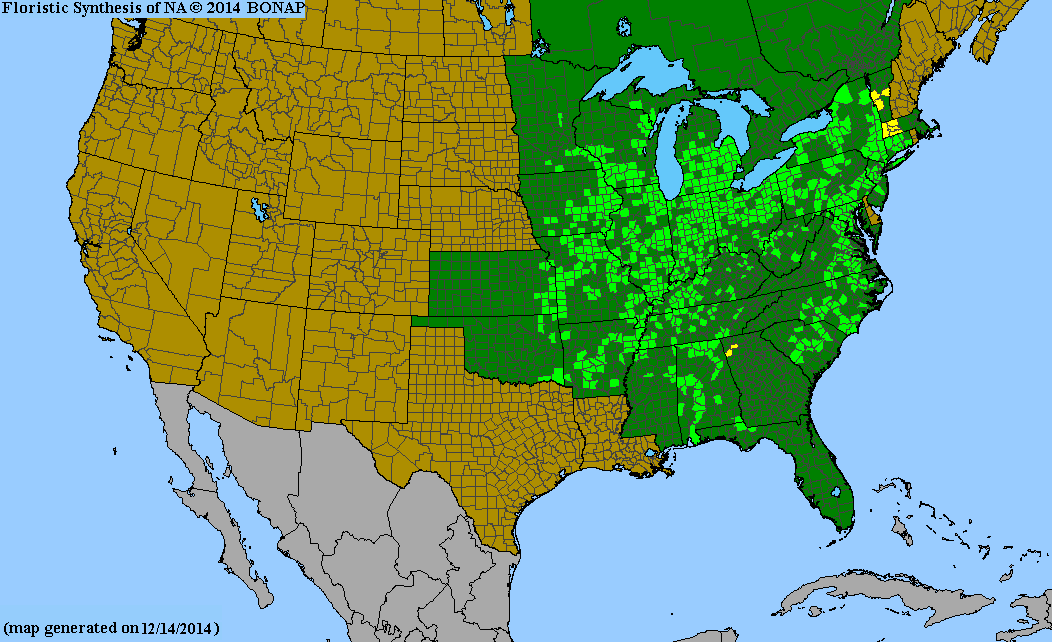
Map Color Key
| Species present in state and native | Species present and not rare | ||
| Species not present in state | Species present and rare |
Kartesz, J.T., The Biota of North America Program (BONAP). 2015. North American Plant Atlas. (http://bonap.net/napa). Chapel Hill, N.C. [maps generated from Kartesz, J.T. 2015. Floristic Synthesis of North America, Version 1.0. Biota of North America Program (BONAP). (in press)].